

Aging is a progressive decline in physiological function characterized by the accumulation of biochemical waste such as Advanced Glycation End products (AGEs). Sugar glycation, a nonenzymatic reaction between reducing sugars and biomolecules like proteins, DNA, and lipids, produces AGEs that impair structural integrity and cellular communication. This review explores the mechanisms by which AGEs accelerate cellular and tissue aging, emphasizing their roles in oxidative stress, inflammation, and metabolic dysfunction. Elevated AGE levels, whether formed endogenously under hyperglycemic conditions or ingested through heat-processed foods, contribute to diabetic complications, cardiovascular diseases, neurodegeneration, and loss of tissue elasticity. Evidence suggests that glycation and oxidative stress share a molecular foundation linking aging and metabolic disorders and also evaluates existing evidence on interventions including dietary AGE restriction, antioxidant therapy, and lifestyle modification to mitigate glycation-induced damage. Advanced glycation end products are key mediators of aging and age-related diseases. Collectively, the findings suggest that aging and diabetes share a molecular basis in oxidative and glycative stress, and that modulating these pathways can extend health span and delay age-related disease progression.
Abstract
Share on Mobile
Scan to access on mobile
Keywords
Advanced Glycation End Products
Aging
Metabolic Waste Accumulation
Nonenzymatic Reaction
Reactive Oxygen Species
Receptor for Ages
INTRODUCTION
Aging is characterized by progressive physiological decline and increased susceptibility to disease, while de-aging-reversing or substantially slowing these processes-represents a new and rapidly advancing frontier in biomedical science The gradual loss of physiological and biochemical processes until death, accompanied by the buildup of biological waste Products that lead to organ and tissue senescence, is known as aging. Reducing sugars bind to amino groups in proteins, DNA, and lipids in a spontaneous, nonenzymatic process known as sugar glycation, which results in Amadori products and irreversible Advanced Glycation End products (AGEs). AGEs accumulation impairs protein function and tissue elasticity, especially in blood vessels, skin, and tendons. Glycation is accelerated in conditions of hyperglycemia and oxidative stress, implicating it in aging and diabetic complications. The body lacks enzymes to remove glycated products, supporting the theory that metabolic waste accumulation drives aging (Kim et al., 2017). Here’s a detailed and up-to-date overview of what is known and being pursued about aging and de-aging as of 2025. India’s geriatric population (aged 60 and above) is a rapidly growing demographic; it was 149 million (10.5%) in 2022 and is projected to more than double to 347 million (20.8%) by 2050.
This represents a significant demographic shift, with the elderly population expanding at a rate faster than younger age groups, and is expected to surpass the population of children by midcentury. An aging population greatly impacts health care and health policy worldwide. By 2030, one in six people globally will be aged 60 or older, with the population of older adults expected to double by 2050. While aging populations began in high-income countries-most notably Japan, where 30% are over 60-developing countries will see the largest increases by 2050. This demographic shift raises major concerns for human health and demands transformative societal changes.
Important challenges include how to remain healthy during longer life expectancy, as aging brings complex health conditions like frailty and sarcopenia, which are associated with increased vulnerability, mortality, and loss of functional capacity. Maintaining good health and quality of life is essential, requiring prevention of geriatric syndromes and interventions to improve health-related quality of life even when such conditions arise (Noto, 2023).
From Sweetness to Stiffness: The Story of AGEs
Decades of investigation have proved that, in the body, glucose and its oxidation by-products irreversibly react with the amino groups of intra- and extracellular long-life proteins, DNA, and lipids. When this set of Maillard reactions takes place in vivo, they are known asnonenzymatic glycosylation or simplyglycation, and they lead to the formation of a heterogeneous set of compounds known as AGEs. Usually, the formation of these AGEs modifies the chemical nature of protein residues (i.e., Lys and Arg), aminophospholipids (i.e., phosphatidylserine and phosphatidylethanolamine), or deoxyribonucleic acids (mainly guanosine on which they are formed. Consequently, this might have dramatic consequences on the intra- and/or intermolecular interaction pattern of the biomacromolecule, and it might lead to macromolecular misfolding, to aggregation, and, as appreciated recently, to the development of glycation-related diseases (mainly diabetes-related diseases) (Uceda et al., 2024).
Advanced Glycation End Products (AGEs) contribute to chronic inflammation, insulin resistance, and Type 2 Diabetes mellitus (T2D). Modern diets rich in exogenous AGEs, especially processed foods cooked at high temperatures, are a significant source of AGEs, which can promote oxidative stress and tissue injury (Vlassara and Uribarri, 2014) Aging involves intrinsic factors (genetics, metabolism, hormones) and extrinsic factors (UV radiation, pollution, smoking) impacting skin aging. Oxidative stress and reactive oxygen species contribute to degradation of collagen and skin aging manifestations such as wrinkles and loss of elasticity The skin’s ability to maintain moisture and repair is impaired with aging, partly due to decreased hyaluronic acid. Telomere shortening with each cell division is a molecular mechanism contributing to cellular aging (Madiha et al., 2018)
In the human body, glycation begins with the formation of a reversible Schiff’s base between sugar carbonyl groups and amino groups of biomolecules, followed by rearrangements to form Amadori products. These undergo further complex oxidative and dehydration reactions, culminating in stable AGEs. AGEs accrue over time and accumulate in long-lived tissues, affecting nearly every cell type and molecule. Their presence alters normal protein structure and function through cross-linking collagen and elastin, leading to tissue stiffness, reduced elasticity, and impaired cellular communication and repair mechanisms.
The accumulation of AGEs is linked with increased oxidative stress and chronic inflammation, further damaging cells and promoting the progression of age-related diseases including diabetes mellitus, cardiovascular diseases, neurodegenerative disorders like Alzheimer’s disease, chronic kidney disease, and osteoporosis. Glycation-associated oxidative damage is exacerbated by hyperglycemic conditions, common in diabetes, and by lifestyle factors like diet, particularly consumption of highly processed, heat-treated foods rich in exogenous AGEs (Takeuchi and Yamagishi, 2009).
Advanced Glycation End products (AGEs) are harmful compounds that are formed when protein or fat combine with sugar in the bloodstream. This process is called glycation. AGEs can also form in foods. Foods that have been exposed to high temperatures, such as during grilling, frying, or toasting, tend to be very high in these compounds. In fact, diet is the biggest contributor of AGEs. Fortunately, your body has mechanisms to eliminate these harmful compounds, including those involving antioxidant and enzymatic activity. Yet, when you consume too many AGEs-or too many form spontaneously your body cannot keep up with eliminating them. Thus, they accumulate. While low levels are generally nothing to worry about, high levels have been shown to cause oxidative stress and inflammation. In fact, high levels have been linked to the development of many diseases, including diabetes, heart disease, kidney failure, and Alzheimer’s, as well as premature aging. Furthermore, people who have high blood sugar levels, such as those with diabetes, are at a higher risk of producing too many AGEs, which can then build up in the body. Therefore, many health professionals are calling for AGE levels to become a marker of overall health (Schmidt et al., 1994). The formation of AGEs are depicted in Figure 1.
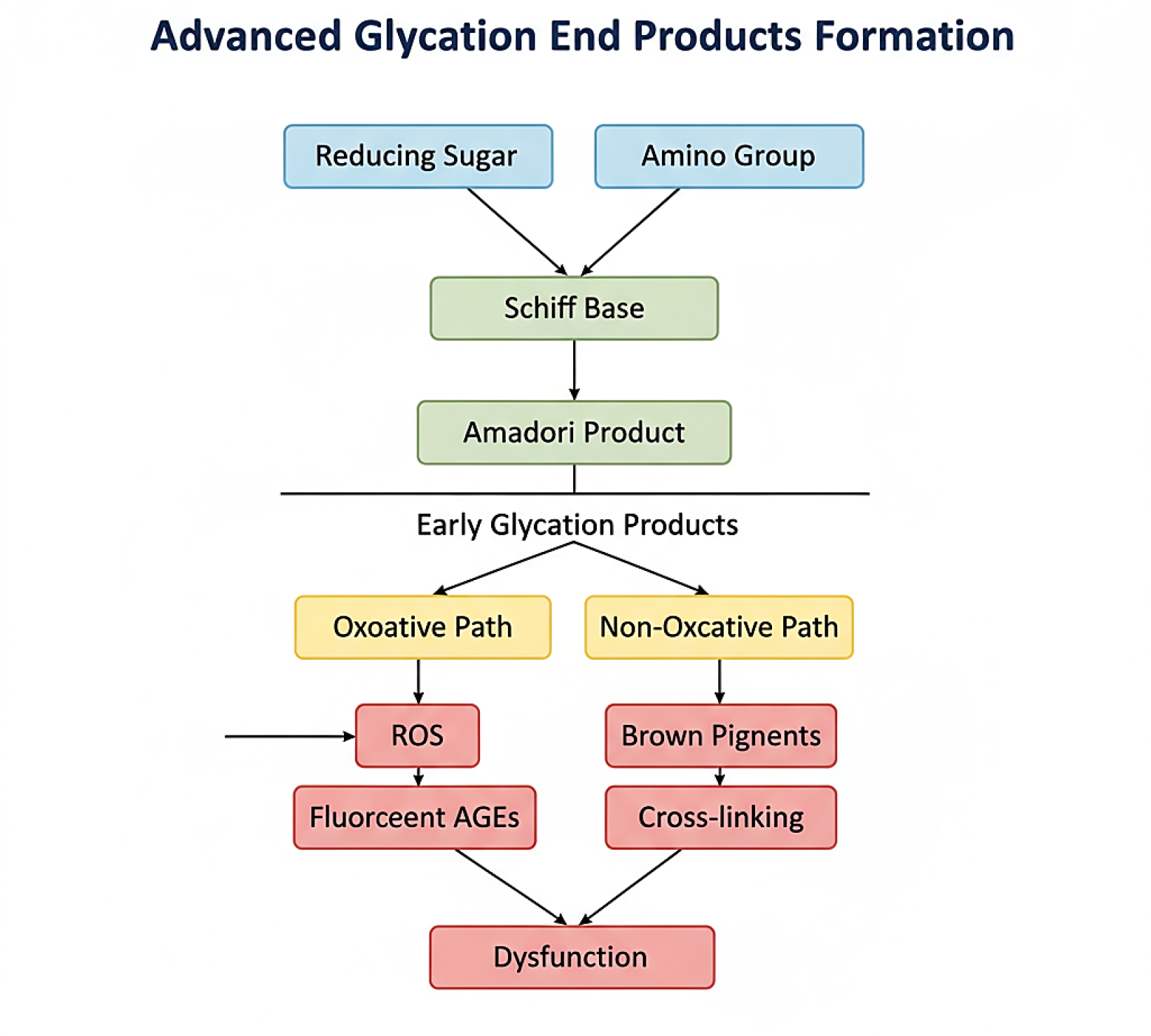
Figure 1:
Formation of advanced glycation end products.
METHODOLOGY
A detailed literature search was conducted across major scientific databases, including PubMed, Scopus, ScienceDirect, SpringerLink, Cochrane and Google Scholar. The search covered publications from 2000 to 2025, emphasizing recent mechanistic and clinical studies on sugar glycation and aging. Additional older landmark studies were included to provide historical and foundational context for AGE discovery and biochemical characterization
This article aims to see how the aging caused by the sugar glycation of AGEs in humans and animals are taken into account in this review. It synthesizes experimental data investigating the role of oxidative stress, glycation mechanisms, and exogenous AGEs in food sources. In terms of methodology, the article gathers research on AGE inhibitors, such as herbal supplements and exercise, and evaluates how well they work to prevent oxidative damage and AGE buildup as people age. To develop effective treatments against glycation-related tissue aging, it assesses existing research findings rather than introducing fresh studies (Kim et al., 2017).
To investigate how AGEs contribute to insulin resistance and consequences from diabetes. In animal models, mice are fed diets containing different amounts of AGE to monitor inflammatory parameters, oxidative stress markers, and insulin sensitivity. Serum AGE levels and the impact of dietary AGE limitation on metabolic outcomes, including insulin resistance and inflammation, are evaluated in human clinical research. Immunoassays that target substances like carboxymethyl lysine are among the AGE measuring techniques. Pharmacological and nutritional therapies targeted at decreasing AGEs or inhibiting AGE receptors (e.g., receptor for AGEs) are also investigated.
This review article also incorporates clinical, demographic, and epidemiological information about aging populations. It looks at health issues that are common in older persons using quality of life assessment instruments like the EQ-5D and global health databases. Cross-sectional and meta-analyses of the variables influencing HRQOL, such as molecular aging indicators like oxidative damage and AGE buildup, are part of the technique. The review highlights intervention options and supports connections between clinical outcomes impacting geriatrics’ quality of life and biological aging mechanisms (Noto, 2023)
The ensemble of studies concludes that aging and diabetes share a molecular genealogy grounded in glycation and oxidative stress, which drive systemic inflammation and functional decline. Yet, aging is modifiable: controlled dietary AGEs, consistent physical exercise, nutritional antioxidant supplementation, and psychosocial engagement form a scientifically supported framework for extending healthy life span. From the biochemical level (AGE-SIRT1 axis) to community health strategies, the collective evidence supports a dual-front approach-reducing glycative burden while enhancing regenerative and adaptive capacity for a longer, healthier life. All the points to the importance of Advanced Glycation End products (AGEs) in hastening the aging process and the emergence of age-related illnesses. Glycation damages the structure and function of proteins, lipids, and DNA by causing them to cross-link, which results in cellular malfunction and a loss of tissue elasticity. Both healthy elderly people and patients with long-term conditions such diabetes, heart disease, renal failure, and Alzheimer’s disease have been found to have elevated AGE levels. Excessive dietary AGEs, particularly from high-heat processed foods, are linked to increased oxidative stress, inflammation, and insulin resistance, according to experimental and clinical research. Insulin sensitivity was enhanced and inflammatory markers were decreased by limiting dietary AGEs or altering cooking techniques (such as steaming or boiling rather than frying or roasting).
CONCLUSION
Advanced Glycation End products (AGEs) play a central role in accelerating aging by damaging proteins, lipids, and DNA, leading to tissue stiffness, oxidative stress, chronic inflammation, and metabolic dysfunction. Their accumulation links aging with major age-related diseases such as diabetes, cardiovascular disorders, neurodegeneration, and renal impairment. Importantly, glycation-driven aging is modifiable. Evidence shows that reducing dietary AGEs, improving glycemic control, engaging in regular physical activity, and enhancing antioxidant defenses can lower AGE burden and slow functional decline. Targeting glycation therefore offers a practical and promising strategy to extend health span and improve quality of life in aging populations.
Acknowledgments
None.
Conflict of Interest
The authors declare that there is no conflict of interest.
References
Kim, C. S., Park, S., Kim, J.. (2017). The role of glycation in the pathogenesis of aging and its prevention through herbal products and physical exercise. Journal of Exercise Nutrition & Biochemistry, 21(3), 55-61. https://doi.org/10.20463/jenb.2017.0027
Madiha, F., Mehran, R., Alia, N., Awan, S. J.. (2018). A systematic review of aging and its causes. International Journal of Development Research, 8(11), 23904-23908.
noto, S.. (2023). Perspectives on aging and quality of life. InHealthcare. MDPI, 11(15), 2131. https://doi.org/10.3390/healthcare11152131
Schmidt, A. M., Hori, O., Brett, J., Yan, S. D., Wautier, J. L., Stern, D.. (1994). Cellular receptors for advanced glycation end products. Implications for induction of oxidant stress and cellular dysfunction in the pathogenesis of vascular lesions. Arteriosclerosis and Thrombosis: A Journal of Vascular Biology, 14(10), 1521-1528. https://doi.org/10.1161/01.ATV.14.10.1521
Takeuchi, M., Yamagishi, S. I.. (2009). Involvement of toxic AGEs (TAGE) in the pathogenesis of diabetic vascular complications and Alzheimer’s disease. Journal of Alzheimer’s Disease, 16(4), 845-858. https://doi.org/10.3233/JAD-2009-0974
Uceda, A. B., Mariño, L., Casasnovas, R., Adrover, M.. (2024). An overview on glycation: Molecular mechanisms, impact on proteins, pathogenesis, and inhibition. Biophysical Reviews, 16(2), 189-218. https://doi.org/10.1007/s12551-024-01188-4
Vlassara, H., Uribarri, J.. (2014). Advanced glycation end products (AGE) and diabetes: Cause, effect, or both?. Current Diabetes Reports, 14(1), 453. https://doi.org/10.1007/s11892-013-0453-1