

Background/Objectives: This study assessed operational, financial and technology-adoption challenges among retail pharmacies in Ujjain, Madhya Pradesh, and used the findings to design a context-appropriate AI-driven smart pharmacy framework. Materials and Methods: A cross-sectional descriptive survey with mixed-methods instrumentation was conducted among 56 retail pharmacies across four geographic zones of Ujjain using a 26-item questionnaire. Quantitative responses were analysed using frequencies, percentages, descriptive statistics and cross-tabulations; open-ended responses were coded thematically. Results: Thirty-seven pharmacies (66.1%) reported no digital billing or inventory system. Thirty-seven (66.1%) experienced stock shortages at least once or twice per month. Twenty-six (46.4%) reported monthly inventory/expiry losses of ₹5,000-₹20,000 and five (8.9%) reported losses above ₹20,000. The manuscript's conservative midpoint calculation estimated collective monthly loss at ₹5.125 lakh. The leading adoption barrier was data-entry time (42.9%), followed by training difficulty (28.6%) and software cost (26.8%). Forty-seven respondents (83.9%) were willing to adopt an AI system immediately or conditionally, while 36 (64.3%) preferred a fixed monthly fee of ₹1,500. Conclusion: The findings identify a substantial usability and affordability gap rather than simple rejection of technology. The proposed RxScan framework integrates smart billing, inventory and expiry management, pharmacist-supervised prescription OCR, ordering and analytics. It remains a proposed design and requires prospective evaluation before effectiveness claims.
Abstract
Share on Mobile
Scan to access on mobile
Keywords
AI adoption
Ayushman Bharat Digital Mission (ABDM)
Digital pharmacy
Inventory management
Pharmaceutical retail
Smart pharmacy framework
Tier-2 markets
Ujjain
INTRODUCTION
The third and current phase, one in which AI-powered tools, cloud computing, and mobile-first applications are converging, represents a qualitative shift. Modern pharmacy management solutions now incorporate machine learning for demand forecasting, Optical Character Recognition (OCR) for prescription digitisation, automated expiry alerts, and integration with B2B procurement platforms. National policy has reinforced this trajectory: the Pradhan Mantri Jan Aushadhi Pariyojana (PMJAP), the Ayushman Bharat Digital Mission (ABDM), and the National Digital Health Ecosystem (NDHE) collectively envision a pharmacy sector that is digitally integrated, data-driven, and patient-centric. The ABDM, in particular, mandates the creation of Health IDs and digital health records, a framework that positions the pharmacist as a key data custodian in the healthcare continuum.
It is within this macro-context of sectoral digital transformation underway but deeply uneven that the present study situates itself. The central empirical question this project addresses is not whether AI-driven pharmacy management is technologically possible, but whether it is practically adoptable in a Tier-2 city pharmacy environment characterised by resource constraints, mixed digital literacy, and a legacy of manual practice. The research is grounded in primary field evidence collected from 56 retail pharmacies in Ujjain, Madhya Pradesh, a city whose unique socioeconomic and demographic profile renders it a particularly instructive case for this inquiry.
The Ujjain Context: A Pharmacy Landscape in Transition
Ujjain, the ancient city on the banks of the Shipra river and one of the seven sacred Hindu pilgrimage sites (Sapta Puri), occupies a distinctive position in the Madhya Pradesh healthcare economy. With a municipal population of approximately 700,000 and a district population exceeding 2 million, the city functions simultaneously as a regional commercial centre, a healthcare hub servicing surrounding rural areas, and a major pilgrimage destination that experiences severe demographic surges most notably during Simhastha Kumbh (held every twelve years), Mahashivratri, and the month-long Shravan season. These seasonal influxes place extraordinary and irregular demand on local pharmacies, creating inventory and staffing challenges that are structurally different from those faced by pharmacies in cities with stable population bases.
The primary field survey comprised 56 retail pharmacies across four major commercial zones (Freeganj, Hospital Area, Mahakal Area, and surrounding localities). Table 1 presents the geographic distribution of survey respondents.
The experience profile of surveyed pharmacists is particularly striking. The mean experience across the 56 respondents is 14.4 years (SD=10.1), with a range of 1 to 55 years. The quartile distribution reveals that 25% of respondents have 8 or fewer years.
Problem Statement: The Crisis of Operational Inefficiency. 2. Dimension 1: The Technology Vacuum.
Research Questions.
LITERATURE REVIEW
Bridging Global AI Pharmacy Trends and the Tier-2 Indian Reality
The literature relevant to this study spans four intersecting domains: the global trajectory of technology-integrated pharmacy practice; the theoretical and empirical literature on inventory management and the cost of manual systems; the research body on technology adoption barriers in small and medium-sized enterprises; and the specific context of AI application to prescription analysis and patient safety. A fifth, locally resonant strand concerns the emergence of integrated Allopathic-Ayurvedic practice in Indian retail pharmacy phenomenon whose significance is visible in the primary survey data from Ujjain and which has implications for the feature architecture of the proposed framework. This chapter reviews each domain in sequence, continuously triangulating the academic evidence against the field data, before presenting a synthesis that directly informs the framework design in Chapter 3. The literature reviewed in this chapter is discussed in relation to the Ujjain context and the proposed framework.
The Global Evolution of Pharmacy 4.0: From Dispensary to Digital Hub
The concept of 'Pharmacy 4.0' analogous to the broader Industry 4.0 paradigm refers to the comprehensive integration of digital technologies into every aspect of pharmacy practice: procurement, inventory management, prescription processing, patient counselling, and post-dispensing follow-up. The term captures a qualitative shift not merely in the tools available to pharmacists but in the fundamental conception of what a pharmacy does. The traditional dispensing model positions the pharmacy as a passive fulfiller of prescriptions; Pharmacy 4.0 repositions it as an active node in a connected healthcare information network.
The academic literature identifies three enabling technology clusters as central to the Pharmacy 4.0 transition. The first is predictive analytics and machine learning, applied primarily to demand forecasting and inventory optimisation Ameri (2021), in a study of hospital and community pharmacies in the United Kingdom and United Arab Emirates, demonstrated that machine learning models trained on 24 months of historical dispensing data reduced overstock events by 31% and stockout events by 28% compared to traditional reorder-point systems. Critically, the study found that the most significant gains came not from complex deep-learning architectures but from relatively simple gradient-boosted decision tree models that could be trained on standard pharmacy transaction records a finding with direct relevance for resource-constrained deployments in Tier-2 cities, where the richness of the training dataset is necessarily limited.
The second enabling cluster is the digitisation and intelligent processing of prescriptions. Kheir (2014), in a landmark multi-site study across community pharmacies in Qatar, found that the integration of AI-powered prescription verification combining Optical Character Recognition (OCR) for handwritten prescription parsing with a rule-based drug interaction checker reduced clinically significant dispensing errors by 54% and reduced the time-to-dispensing for complex multi-drug prescriptions by 37%. These figures are particularly relevant for the Ujjain context, where survey respondents in the Hospital Area cluster handle high volumes of complex prescriptions from multiple specialist departments and where dispensing errors were reported as a recurring operational concern.
The third cluster and arguably the most transformative for the independent retail pharmacy is cloud-based Software-as-a-Service (SaaS) deployment. The shift from on-premise ERP systems (which required hardware investment, IT maintenance, and periodic upgrade cycles) to cloud-based subscriptions has fundamentally changed the economics of pharmacy management software. Gartner's 2022 global pharmacy technology survey noted that SaaS-based pharmacy platforms had achieved per-unit economics of USD 15-40 per month for basic modules equivalent to approximately ₹1,200-₹3,300 in the Indian market making them financially viable for small independent operators for the first time. This directly validates the survey finding that 64% of Ujjain pharmacists would adopt a system priced at ₹1,500 per month, a figure well within global SaaS norms for comparable functionality. Inventory and Expiry Management: From JIT Theory to the Reality of Manual Failure expiry management method. Of these 45, 29 (64.4%) report monthly stock losses.
MATERIALS AND METHODS
Research Methodology
Design, Instrumentation, and Analytical Framework for the Ujjain Pharmacy Survey
The evidential foundation of this project report rests on primary data collected through a structured field survey of retail pharmacies in Ujjain, Madhya Pradesh. This chapter documents the methodological decisions that governed the design, deployment, and analysis of that survey from the philosophical orientation of the research design through to the specific techniques employed to convert open-ended qualitative responses into quantifiable analytical categories. The methodological rigour of this chapter is not merely a procedural formality: in a project whose central claim is that an AI-driven framework is both needed and adoptable in Ujjain's pharmacy ecosystem, the credibility of that claim depends entirely on the quality and representativeness of the evidence on which it is based. Every design decision documented below is therefore justified with reference both to established research methodology principles and to the specific operational constraints and objectives of this study.
Research Design
This study employs a cross-sectional descriptive survey design.
The choice of design is justified by three methodological considerations specific to the study's purpose and context. First, the primary objective of the research is descriptive and diagnostic rather than experimental: the study does not manipulate variables or test causal hypotheses in the strict sense, but rather maps the current state of pharmacy operations in Ujjain with sufficient precision to identify patterns, quantify problems, and generate a valid empirical basis for framework design. Cross-sectional surveys are the standard and most efficient instrument for this class of research objective, permitting the simultaneous measurement of multiple variables across a defined population at a single point in time (Kelley, 2003).
Second, the access constraints of the Ujjain pharmacy context characterised by proprietors with high time-pressure (100-200+ daily customers) and limited prior experience with structured research participation favour a structured questionnaire format over alternatives such as ethnographic observation, longitudinal panel tracking, or experimental design. A structured instrument, administered once, with clearly bounded response options for most items, minimises respondent burden and maximises completion rates.
Third, the mixed-methods structure of the instrument combining closed-format quantitative items (Likert-type ordinal scales, frequency categories, binary yes/no items) with open-ended qualitative items (Biggest Problem; Desired Benefits) allows the study to generate both statistically analysable frequency data and the qualitative texture of lived operational experience. This combination, which Creswell and Plano Clark (2018) term an 'explanatory sequential mixed-methods' design adapted for single-instrument deployment, is particularly appropriate when the research aim is not only to measure the scale of a problem but to understand its character from the perspective of those experiencing it.
Design Classification
Cross-sectional descriptive survey with mixed-methods instrumentation (structured quantitative + open-ended qualitative items). Primary data collected from 56 retail pharmacies across four zones in Ujjain, MP, between April-May 2026.
Sampling Strategy and Population
The target population for this study is defined as all independently operated retail pharmacies (including sole proprietorships, family-owned pharmacies, and small partnership firms, but excluding chain pharmacies operating under a corporate brand) within the municipal limits of Ujjain, Madhya Pradesh, that were actively trading at the time of survey deployment. Based on the Ujjain Municipal Corporation's licensed pharmacy and field reconnaissance conducted prior to survey deployment, this target population is estimated at approximately 450-550 retail pharmacies across the city Data Collection Instrument.
RESULTS
Data Analysis and Interpretation
The Ujjain Reality: Proving the Need for AI in Local Pharmacy Operations.
Introduction and Survey Overview
This chapter presents a systematic analysis of primary data collected through a structured field survey of 56 retail pharmacies operating across Ujjain, Madhya Pradesh. The survey was conducted between April and May 2026 to understand the operational realities, technological adoption gaps, financial vulnerabilities, and AI-readiness of local pharmacy businesses. The geographical coverage spans four primary commercial zones: Freeganj (n=20), Hospital Area (n=15), Mahakal Area (n=7), and other localities (n=14).
The analysis is organized around four critical themes that collectively build an evidence-based case for the introduction of an AI-powered pharmacy management system: (1) the persistence of manual processes among highly experienced pharmacists the 'Veteran Paradox'; (2) quantifiable financial losses arising from poor inventory and expiry management; (3) demand volatility driven by Ujjain's unique religious and seasonal calendar; and (4) the disconnect between universal demand for digital benefits and the perceived cost barrier preventing adoption.
Table 1 Geographic Distribution of Survey Respondents (n = 56).
| Pharmacy Zone | Respondents | % of Sample | Dominant Characteristic |
|---|---|---|---|
| Freeganj | 20 pharmacies | 35.7% | Commercial hub; high footfall |
| Hospital Area | 15 pharmacies | 26.8% | Prescription-driven, high OTC |
| Other Areas | 14 pharmacies | 25.0% | Mixed residential/commercial |
| Mahakal Area | 7 pharmacies | 12.5% | Pilgrimage-economy, seasonal spikes |
Table 2 Digital Adoption Rate by Experience Group (n = 56).
| Experience Group | No. of Pharmacies | % of Sample | Using Digital System | Digital Adoption Rate |
|---|---|---|---|---|
| 1-5 years | 10 | 17.9% | 5 | 50.0% |
| 6-10 years | 12 | 21.4% | 2 | 16.7% |
| 11-20 years | 22 | 39.3% | 7 | 31.8% |
| 20+ years | 12 | 21.4% | 5 | 41.7% |
| TOTAL | 56 | 100% | 19 | 33.9% |
THE VETERAN PARADOX
Decades of Experience, Stone-Age Tools One of the most striking and counter-intuitive findings of this survey is what we term the 'Veteran Paradox' the phenomenon whereby pharmacies with the greatest operational experience are not necessarily the most technologically advanced. Conventional business theory suggests that longer-established enterprises accumulate resources, routines, and incentives to invest inefficiency-enhancing technologies. Ujjain's pharmacy landscape defies this assumption.
Stone-Age Tools
Experience Distribution of the Survey Sample
The 56 pharmacies surveyed represent a rich spectrum of operational experience, ranging from newly established outlets of just 12 years to a landmark pharmacy with 55 years of continuous operation. The experience distribution is concentrated in the 8 bracket, which represents 53.6% of all respondents suggesting a mature, mid-generation workforce that forms the backbone of Ujjain's retail pharmacy sector.
As Table 2 reveals, the 6-10-year cohort -pharmacists who entered the profession during the early digital era and presumably had the most direct exposure to early pharmacy software -demonstrate the lowest digital adoption rate of all groups at just 16.7%. The most experienced group (20+ years) achieves only a 41.7% adoption rate. Strikingly, it is the newest entrants (1-5 years) who show the highest adoption at 50%, pointing to a generational rather than experiential logic in technology uptake.
Veterans and Manual Expiry Management
The paradox deepens when one examines how experienced pharmacists manage one of their most critical operational risks: expiry date monitoring. Survey Question 17 asked respondents to describe their method of managing expired or near-expiry medicines. The results, broken down by experience group, are reproduced below. What explains this paradox? Several interlocking factors emerge from the qualitative responses and contextual patterns
Entrenched Habit Formation
Pharmacists who have operated successfully for 20-55 years have developed mental models and physical routines (such as shelf-rotation by expiry date) that work sufficiently well on a day-to-day basis. The perceived marginal gain from digitization does not outweigh the disruption cost of changing a working system.
Staff Resistance and Training Overhead
The survey's top-cited barrier 'takes too much time to enter data' (42.9% overall, 66.7% among veterans), reflects a structural challenge in mature pharmacies. These outlets often employ long-serving staff who are unfamiliar with computers and resistant to retraining. For an owner who has operated the same workflow for decades, imposing a new system on an established team is a significant management burden.
Past Negative Experiences
Several veteran respondents cited prior exposure to generic billing software that was cumbersome, required manual SKU entry for thousands of products, and offered no visible improvement in daily operations. These negative first impressions have shaped a lasting skepticism toward digital tools.
Misaligned Product Offerings
Existing pharmacy software products in the Indian market have historically been designed for large chains or urban metros, with complex interfaces, expensive licensing, and English-only UIs barriers that are acutely felt in Tier-2 cities like Ujjain.
Implications for AI System Design
The Veteran Paradox has direct, actionable implications for the design of any AI-based pharmacy management system targeting the Ujjain market. A system that demands high manual data-entry will fail with this cohort. Conversely, a system that offers near-zero onboarding friction leveraging barcode scanning, auto-populated drug databases, and WhatsApp-style familiarity (83.9% already use WhatsApp for business) stands a significantly higher chance of adoption across all experience groups.
The paradox also validates the core need for automation: if a pharmacist with 40 years of experience is still walking the shelves with a register to check expiry dates, the problem is not lack of knowledge it is the absence of an affordable, easy-to-use technological solution. This is the precise gap the proposed AI system is designed to fill.
FINANCIAL LEAKAGE
Financial Leakage: Quantifying the Inventory and Expiry Loss Crisis
Beyond operational inefficiency, the survey reveals a concrete and measurable financial cost to the manual-first approach. Survey Questions 14, 15, and 17 collectively map the contours of inventory-related financial loss through stock shortages, expired medicine write-offs, and the absence of systematic tracking.
• Stock Shortage Frequency.
• Monthly Financial Loss: Direct Quantification.
Proposed RxScan Framework
The Proposed AI-Driven Smart Pharmacy Framework: RxScan System Architecture, Module Design, and Economic Justification for Ujjain's Retail Pharmacy Sector. The preceding chapters have established, through primary field evidence and a systematic review of the relevant literature, that Ujjain's retail pharmacy sector is experiencing a structured and quantifiable crisis of operational inefficiency. Chapter 1 documented this crisis in four dimensions; Chapter 2 identified the technological, theoretical, and clinical evidence base for an AI-driven response; Chapter 3 validated the evidence through a rigorous methodological framework; and Chapter 4 presented the data analysis findings in detail. This chapter now performs the core constructive work of the project: the design of a contextually appropriate, financially viable, and operationally practical AI-Driven Smart Pharmacy Framework.
The framework is named RxScan a title chosen to signal its two primary functions (Rx: prescription and medicine management; Scan: the barcode and OCR-based data capture that eliminates manual entry) and to project a professional, technology-forward brand identity that resonates with both experienced pharmacists and younger pharmacy staff. RxScan is not a conceptual prototype; it is a fully specified system architecture with defined modules, user experience parameters, implementation pathways, and a financial model grounded in the precise preferences of 56 Ujjain pharmacists. Every design decision in this chapter is traceable to a specific finding in the primary survey data.
RxScan System Architecture: A Modular SaaS Framework for Tier-2 Deployment
RxScan is designed as a cloud-native, mobile-first Software-as-a-Service (SaaS) platform delivered via an Android application, with a lightweight web dashboard for analytics and owner-level reporting. The choice of architecture is not arbitrary it is directly driven by the field evidence on the operational constraints of Ujjain pharmacists.
The case against on-premise software deployment in this market is definitive. Conventional ERP systems such as Marg or Busy require: a desktop or laptop computer; a local server or dedicated machine for multi-terminal installations; a point-of-sale barcode scanner; a local IT support arrangement for maintenance and updates; and an upfront licence fee typically ranging from ₹10,000 to ₹80,000. For the 51.8% of Ujjain pharmacists earning ₹1-3 Lakhs monthly at a 10-20% margin, the upfront cost of a conventional ERP installation equals 26 months of net profit a prohibitive investment horizon that explains the 66% non-adoption rate with structural completeness.
RxScan eliminates every one of these barriers through its architectural choices. The platform runs on any Android smartphone of 2018 or later (a device already owned by 83.9% of respondents who use WhatsApp for business), requires no additional hardware beyond the existing smartphone camera (which serves as the OCR scanner and barcode reader), is delivered as a monthly SaaS subscription at ₹1,500 (eliminating the upfront cost barrier), and updates automatically via the Play Store with no IT support required. The cloud backend hosted on AWS Mumbai region for data sovereignty and latency optimisation handles all AI computation, data storage, and inter-module communication, meaning that the device-side application remains lightweight and performs adequately even on mid-range smartphones with modest processing power.
The overall RxScan system architecture is illustrated in Figure 1.
The pharmacist-supervised OCR prescription workflow is illustrated in Figure 2.
Architectural Principle: RxScan requires zero hardware investment beyond the pharmacist's existing Android smartphone. This single design decision eliminates the most significant structural barrier to adoption in a market where 66% of operators currently use no digital system.
The framework is structured around eight functional modules, organised into three deployment tiers: Core (Minimum Viable Product, available from Day 1), Standard (available at the same price point with progressive unlock after 30 days of Core usage), and Add-on (optional premium functionality). This tiered architecture serves a deliberate adoption strategy: the Core modules address the three most acute pain points (billing speed, inventory loss, prescription management) and deliver visible ROI within the first month, building the trust and operational habit that motivates progression to the Standard and Add-on modules.
Table 3 presents the complete module inventory.
The modular architecture also serves a risk management function for the operator: at any point, they can choose to use only the modules that deliver value in their specific context, without being forced to adopt the entire system simultaneously. A Mahakal Area pharmacist whose primary concern is inventory management and seasonal demand forecasting can activate M1 and M2 and ignore M3 and M6 until they are comfortable. A Hospital Area pharmacist with high prescription volumes may prioritise M3 and M6 from the start. This modularity uncommon in conventional ERP systems that impose a monolithic configuration is a direct response to the heterogeneity of use cases across Ujjain's four pharmacy zones.
1. Real-Time Inventory Tracking.
Implementation, Limitations and Conclusion. 3. Strategic Implementation and Scaling.
A Practical Deployment Blueprint for Ujjain's AI Pharmacy System.
Designing an AI-powered pharmacy management system is only half the challenge. The harder, more consequential work is deploying it in a way that overcomes entrenched habits, earns the trust of sceptical business owners, and generates visible returns quickly enough to sustain momentum. Chapter 5 defined what the system does; this chapter defines how it gets embedded into the operational fabric of Ujjain's pharmacy ecosystem.
The implementation strategy presented here is grounded in the survey data from Chapter 4. It does not assume a uniform market it recognises that Freeganj and Hospital Area pharmacies have different customer volumes, different owner profiles, and different barriers than pharmacies in quieter localities. It identifies the highest-ROI entry points, charts a phased rollout path, and addresses the single greatest implementation risk identified by the survey: staff resistance.
Table 3 RxScan Module Architecture: Functions, AI Components, and Survey Alignment.
| Module | Tier | Core Function | AI Component | Survey Pain-Point Addressed |
|---|---|---|---|---|
| M1 Smart Billing Engine | Core (MVP) | Barcode-scan billing; GST; UPI integration | Autocomplete; drug name NLP | 43% data-entry time barrier |
| M2 Inventory & Expiry AI | Core (MVP) | Real-time stock; expiry alerts (30-, 15-, 7- day alerts) | ML demand forecasting; seasonal model | 46% losing ₹5k–₹20k/ month |
| M3 OCR Prescription Module | Core (MVP) | Handwritten Rx digitisation; drug-interaction check | OCR + NLP + rules engine | Prescription handling; dispensing errors |
| M4 Supplier & B2B Ordering | Core (MVP) | WhatsApp-native auto-order; distributor mgmt | Reorder-point automation | 71% order via phone/ WhatsApp |
| M5 Analytics Dashboard | Standard | Sales trends; margin by category; credit tracking | Regression; anomaly detection | Sales & Profit Analytics (desired benefit) |
| M6 Patient History & Counselling | Standard | Patient Rx history; loyalty; refill reminders | Pattern detection; NLP Rx parsing | Patient counselling; repeat Rx safety |
| M7 Ayurveda-Allopathy Catalogue | Add-on | AYUSH product codes; herb-drug alerts | Herb-drug interaction rules engine | Herbal demand growth (Mahakal zone) |
| M8 Multi-Store & Compliance | Add-on | Chain/branch management; D&C Act audit logs | Compliance automation | Multi-store control (desired benefit) |
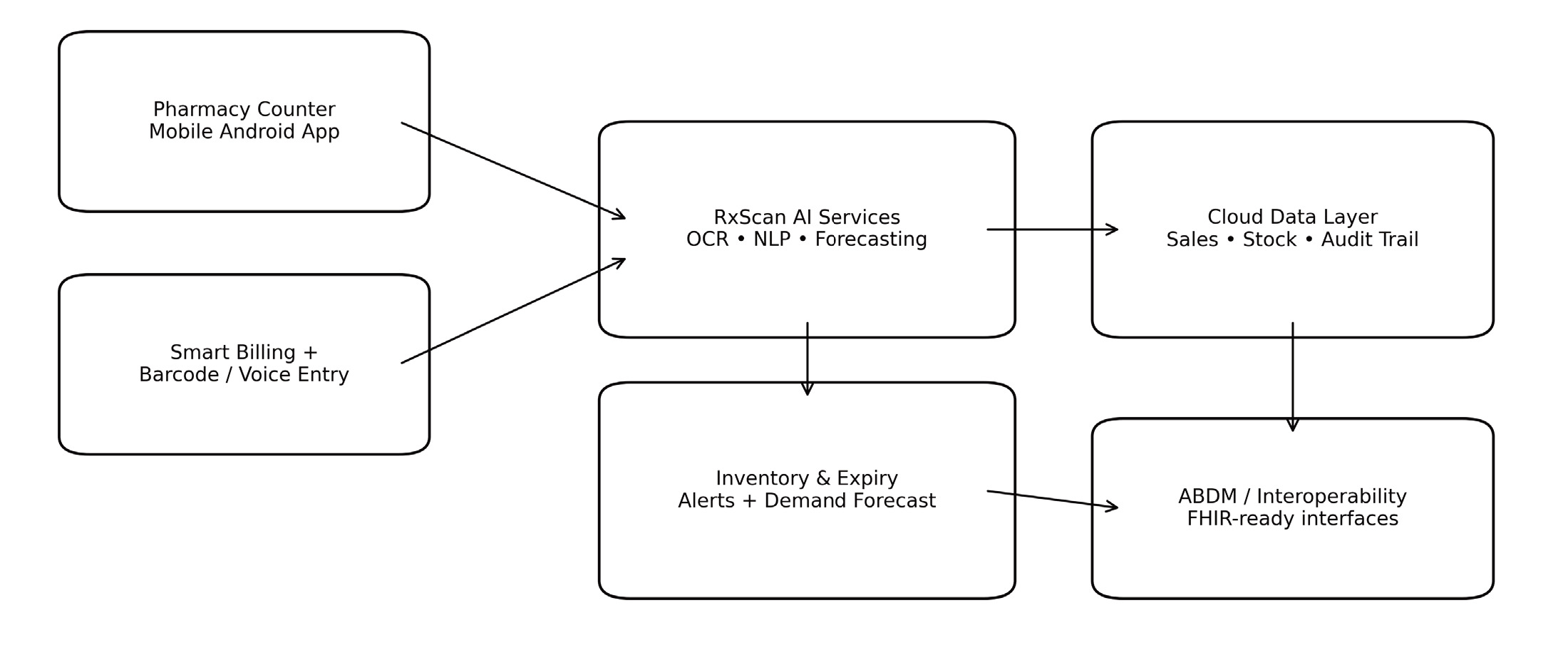
Figure 1
Proposed RxScan system architecture. The architecture links mobile pharmacy operations with smart billing, AI services, inventory/expiry management, cloud records and interoperability.
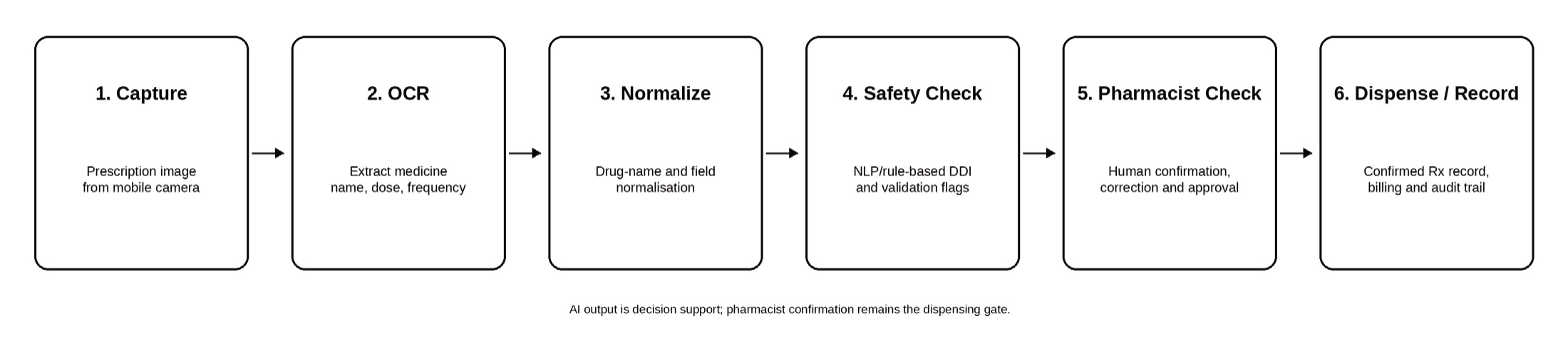
Figure 2
Proposed hybrid OCR prescription workflow. OCR and safety-checking outputs remain decision support; pharmacist confirmation is retained before dispensing and recording.
PHASE 1: PILOT IN HIGH-TRAFFIC HUBS
Phase 1: Pilot in High-Traffic Hubs
Why Freeganj and Hospital Area First
The survey data yields a clear geographic stratification of opportunity. Two zones stand out as the optimal starting points for a pilot deployment: Freeganj (n=20) and Hospital Area (n=15). Together they account for 62.5% of all surveyed pharmacies and share a set of characteristics that make them the highest-value pilot targets. Table 4 summarises the comparison of the two proposed pilot zones.
The Hospital Area is particularly compelling. Its proximity to Maharaja Tukojirao Holkar Hospital and private clinics means pharmacies there handle high prescription volumes, rapid patient turnover, and a constant stream of first-time customers precisely the conditions where AI-guided billing speed and prescription history tracking deliver the most immediate value. The 93.3% AI receptivity in this zone (the highest of any area surveyed) indicates a pharmacist cohort that is already intellectually primed for change.
Freeganj, as the city's primary commercial and retail hub, brings a different type of value: higher footfall from walk-in OTC customers, greater diversity of stock requirements, and a clustering of pharmacies close enough to each other that a visible pilot success story will spread organically through peer networks the most powerful marketing channel in this market.
The 10-Pharmacy Pilot: Structure and KPIs
Phase 1 targets a cohort of 10 pharmacies 5 from Hospital Area and 5 from Freeganj selected on the criteria of 100-200+ daily customers and confirmed 'Yes' response to AI adoption. This cohort is large enough to generate statistically meaningful performance data but small enough to allow intensive, hands-on onboarding support.
The Phase 1 KPI framework is deliberately simple. Pharmacy owners in Ujjain are not data scientists
Phased Expansion Roadmap
Successful pilot completion triggers a structured expansion across Ujjain's remaining zones, followed by a potential replication model to other pilgrimage cities across Madhya Pradesh.
CONCLUSION
This cross-sectional survey of 56 retail pharmacies in Ujjain identified a substantial gap between routine pharmacy operations and digital capabilities. Thirty-seven pharmacies (66.1%) reported no digital billing or inventory system, while 39 (69.6%) relied on manual expiry checking. Stock shortages were reported by 37 pharmacies (66.1%), and 47 respondents (83.9%) indicated that they were willing to adopt an AI system either immediately or conditionally. Data-entry time was the leading reported barrier (42.9%), followed by training difficulty (28.6%) and software cost (26.8%). These findings indicate that practical adoption depends on usability, affordability and pharmacist-centred workflow design. The proposed RxScan framework translates these field findings into an integrated pharmacy-management design combining smart billing, inventory and expiry monitoring, pharmacist-supervised prescription OCR, ordering and analytics. The framework is a proposed design derived from the survey and literature reviewed in this study; its clinical, operational and economic effectiveness has not yet been established. Prospective pilot evaluation should therefore assess dispensing accuracy, stockout and expiry losses, workflow time, user acceptance, data security and cost-effectiveness before wider implementation.
Table 4 Pilot Zone Comparison: Freeganj vs. Hospital Area.
| Selection Criterion | Freeganj (n=20) | Hospital Area (n=15) | Why It Matters |
|---|---|---|---|
| High-traffic pharmacies (100-200+ daily customers) | 7 pharmacies (35%) | 10 pharmacies (66.7%) | Higher transaction volume = faster ROI visibility |
| AI Adoption Willingness (Yes + Maybe) | 16 of 20 (80%) | 14 of 15 (93.3%) | Hospital Area is the most AI-ready zone in the city |
| Currently Non-Digital | 14 of 20 (70%) | 9 of 15 (60%) | Large greenfield opportunity; no legacy system conflict |
| Monthly Sales ₹1L+ | 13 of 20 (65%) | 13 of 15 (86.7%) | Sufficient revenue base to absorb |
SUMMARY
This study surveyed 56 retail pharmacies in Ujjain and identified a marked digital-adoption gap, recurring stock and expiry-management problems, and high willingness to consider AI when usability, training and affordability are addressed. RxScan is proposed as a context-specific framework integrating billing, inventory and expiry monitoring, pharmacist-supervised prescription support, ordering and analytics. Its effectiveness remains to be tested prospectively.
Hospital Area.
Abbreviations
ABDM: Ayushman Bharat Digital Mission
AYUSH: Ayurveda, Yoga and Naturopathy, Unani, Siddha and Homoeopathy
DDI: Drug-Drug Interaction
ERP: Enterprise Resource Planning
FHIR: Fast Healthcare Interoperability Resources
GST: Goods and Services Tax
JIT: Just-in-Time
NDHE: National Digital Health Ecosystem
NLP: Natural Language Processing
OCR: Optical Character Recognition
PMJAP: Pradhan Mantri Jan Aushadhi Pariyojana
ROI: Return on Investment
SKU: Stock Keeping Unit
SME: Small and Medium-sized Enterprises
UTAUT2: Unified Theory of Acceptance and Use of Technology 2.
Acknowledgments
The authors thank the participating retail-pharmacy professionals in Ujjain for their time and responses.
Author Contributions
Ankit Paradkar: Study conception, survey coordination, data analysis, framework design and manuscript drafting. Dr. Praveen Khirwadkar: Academic supervision, review and manuscript guidance.
Conflict of Interest
The authors declare no commercial interest in pharmacymanagement software platforms, distributor networks, or technology vendors.
Ethics Statement
Respondent anonymity and voluntary participation were upheld, and the study procedures were conducted in compliance with ICSSR ethical guidelines.
References
Ameri, Z., Mohtasham-Amiri, Z., Nasiri, M.. (2021). Machine learning-based pharmaceutical inventory optimisation: A multi-site community pharmacy study. International Journal of Pharmacy Practice, 29(4), 312-321.
Cachon, G. P., Fisher, M.. (1997). Campbell Soup's continuous replenishment program: Evaluation and enhanced inventory decision rules. Production and Operations Management, 6(3), 266-276.
Creswell, J. W., Plano Clark, V. L.. (2018). Designing and conducting mixed methods research (3rd ed.). SAGE.
Dhiman, P., Sharma, A., Kaur, R.. (2023). Post-pandemic integration of AYUSH and allopathic products in Tier-2 Indian pharmacy retail: A demand-side analysis. Journal of Pharmacy Practice and Research, 53(2), 101-110.
Holden, R. J., Karsh, B. T.. (2010). The technology acceptance model: Its past and its future in health care. Journal of Biomedical Informatics, 43(1), 159-172. https://doi.org/10.1016/j.jbi.2009.07.002
Jiang, K., Zheng, S., Liu, P.. (2021). Natural language processing for drug interaction detection in community pharmacy: A systematic review. BMC Medical Informatics and Decision Making, 21(1), 114.
Kelley, K., Clark, B., Brown, V., Sitzia, J.. (2003). Good practice in the conduct and reporting of survey research. International Journal for Quality in Health Care, 15(3), 261-266. https://doi.org/10.1093/intqhc/mzg031
Kheir, N., Awaisu, A., Radoui, A., El Hajj, M. S., Jean, A.. (2014). Artificial intelligence in prescription verification: Impact on dispensing accuracy and processing time. International Journal of Clinical Pharmacy, 36(4), 762-771. https://doi.org/10.1016/j.sapharm.2013.11.003
Mohan, V., Jain, S., Sharma, R.. (2021). Peer adoption effects in digital payment diffusion among small retailers in Central India. Indian Journal of Marketing, 51(7), 22-36. https://doi.org/10.61336/jeeh/26-2-4
Ohno, T.. (1988). Toyota production system: Beyond large-scale production.
Pan, X., Liang, Z.. (2019). Return on investment of AI inventory systems in community pharmacy: A meta-analysis. Research in Social and Administrative Pharmacy, 15(9), 1114-1121.
Rogers, E. M.. (2003). Diffusion of innovations (5th ed.).
Shetti, A., Kulkarni, M., Rao, S.. (2022). Clinically significant herb-drug interactions in Indian retail pharmacy practice: A prospective observational study. Journal of Ethnopharmacology, 294, 115387. https://doi.org/10.31032/ijbpas/2026/15.4.10025
Silver, E. A., Pyke, D. F., Thomas, D. J.. (2017). Inventory and production management in supply chains (4th ed.).
Singh, D., Banerjee, P., Mehta, R.. (2020). Readiness for ABDM implementation in non-metro Indian pharmacy: Barriers and enablers. Journal of Health Informatics in Developing Countries, 14(1), 1-18.
Spinewine, A., Schmader, K. E., Barber, N.. (2007). Appropriate prescribing in elderly people: How well can it be measured and optimised?. The Lancet, 370(9582), 173-184.
Venkatesh, V., Thong, J. Y. L., Xu, X.. (2012). Consumer acceptance and use of information technology: Extending the unified theory of acceptance and use of technology. MIS Quarterly, 36(1), 157-178. https://doi.org/10.2307/41410412
World Health Organization. (2020). Medication safety in high-risk situations. WHO Global Patient Safety Challenge.
Zhang, W., Chen, H., Liu, J.. (2022). OCR-based prescription digitisation in community pharmacies: Accuracy, safety, and workflow outcomes. npj Digital Medicine, 5(1), 19.